


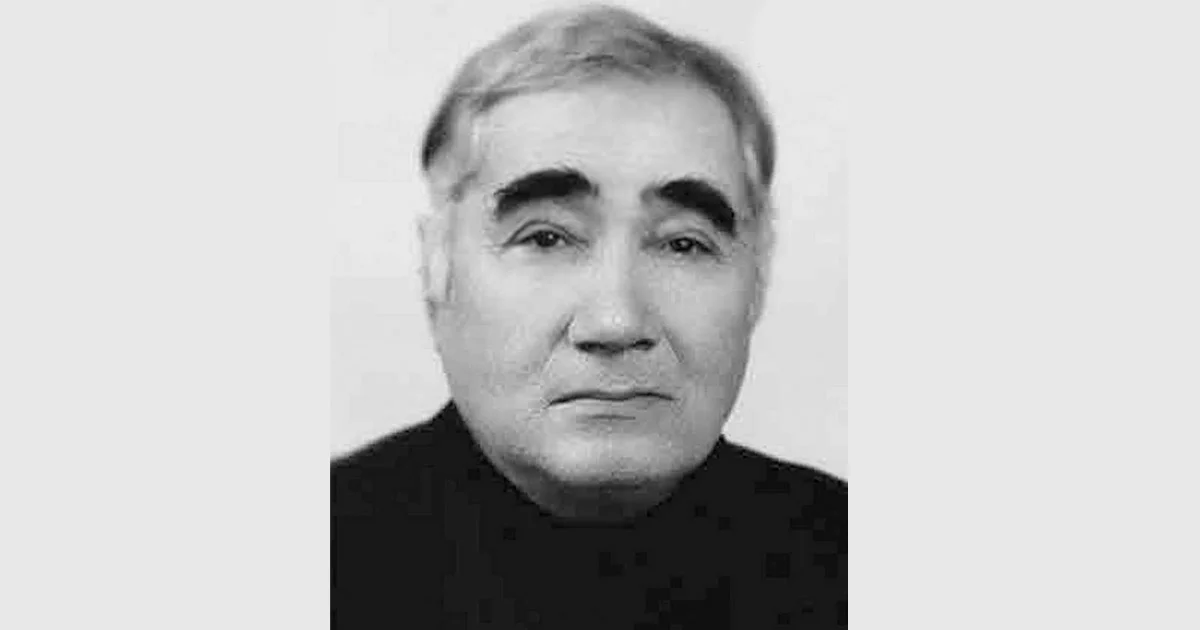
Date of birth - 21 April 1923
Place of birth - Anaga Village, Sighnaghi Municipality
Date of death - 5 May 2007, aged 84
Place of death - Tbilisi, Georgia
Occupation: Writer, physician, and poet
Shalva Mchedlishvili spent his childhood in Kakheti, in the village of Anaga. The poet’s parents were a teacher and a physician in Kardenakhi (Mrs. Nino’s mother, Eva Martashvili, was also a well-known traditional healer). His parents taught in the school building that had belonged to the Foraqishvili family before the Sovietization. Through the efforts of Shalva’s father, Zakaria, the Foraqishvili family was given one of the best rooms in their former home. The widow of the late Foraqishvili and her 16-year-old daughter lived there, and they often read poems to young Shalva and told him fairy tales.
Shalva’s father, Zakaria, and his brother, Lado Mchedlishvili, established singing ensembles. In connection with the 1924 uprising, both were subjected to repression and narrowly escaped execution.
Shalva’s mother, Nino Tushishvili, was a romantic by nature. From an early age, she instilled in her son a love for Ilia, Akaki, Vazha, Iakob Gogebashvili, and Nikoloz Baratashvili.
From 1930, the Mchedlishvili family settled in Tbilisi. Young Shalva was enrolled in the First Experimental Demonstration School (today known as Tbilisi Classical Gymnasium), which he graduated from in 1940. After graduating from school, he submitted his documents to the Faculty of Language and Literature, but his parents withdrew his documents from the university and submitted them to a medical institute instead.
On 27 March 1945, at the age of 22, Shalva Mchedlishvili was arrested for his “ideologically unacceptable” poems. Initially, he spent more than two years in the prison of the People’s Commissariat for Internal Affairs in Tbilisi, under Articles 10 and 11 of Article 58. This meant charges of agitation, organization, and anti-Soviet propaganda, which carried the death penalty until 1945. The young poet’s case was defended by Shalva Aleksi-Meskhishvili, a member of the National Council of Georgia, who managed to have the death-penalty charge changed. Later, under a special decree, Shalva Mchedlishvili, like all political prisoners, was exiled. From 1949, he was held in prisons in Baku, Rostov-on-Don, and Vologda, and was exiled to the Far North. He served his sentence in the Vorkuta forced-labor camp, where he had to work in Coal Mine No. 6, the harshest and most difficult mine. After Stalin’s death, the poet was released from the Vorkuta forced-labor camp, but instead of returning home, he was sent into permanent exile to the city of Karaganda in the Kazakh Republic. There, while in exile, he graduated from the Karaganda Medical Institute.
Shalva returned from exile under an amnesty and remained in exile. His poems were not published, as censorship prohibited his creative work. He was forbidden to live in the capital and remained under surveillance. For many years, he worked as a physician at various resorts in Georgia, including Shovi, Borjomi, Gagra, Tskaltubo, and Akhtala.
He published more than 10 books and was the author of scientific and journalistic works.
Family
Shalva Mchedlishvili’s first wife was the poet Anna Kalandadze. He later married Eter Arabuli, with whom he had two daughters and one son.